sglux - house of photodiodes - from 120nm to 1700nm
Customized special design from vacuum to infrared
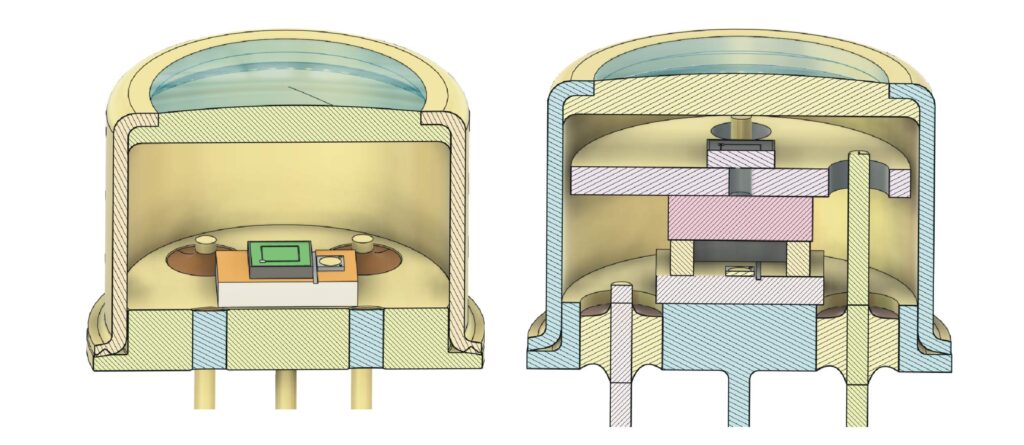
sglux has established itself as a well-known brand for SiC photodiodes and sensors worldwide. Going this path, sglux has ventured into designing of customer-specific photodiodes, becoming a one-stop agency for all measurement requirements in the wavelength range from vacuum UV to infrared radiation. These can incorporate one or more chips, filters and optics, SiO₂ diffusers or VUV-transparent MgF based windows.
Our offering
• Application-specific design of detectors or assemblies based on SiC, GaP, InGaP, InGaAs, Si, Ge, or any other material suitable for the application
• Use of commercially available optical filters, diffusers, and lenses, as well as in-house development if these are not available on the market.
• Integration of temperature sensors
• Circuit development for processing photocurrents (often only a few nA) into standard process variables, such as 0-5V, 4-20mA, or digital, for use in photodiode housings (sglux TOCONs) or outside
• Assembly and connection technology
• Development of special housings
Our strengths
• We enjoy implementing special concepts and have over 20 years of experience in building complex detectors with or without amplifiers, with or without filters, with one or more different chips, always with the highest possible precision and long-term stability.
• In-house production of SiC photodiode chips in three variants: standard, VUV, and APD, as well as the production of InGaP photodiode chips.
• Extensive experience in working with other chips, such as GaP, InGaAs, Si, Ge.
• High-performance calibration laboratory with first-class equipment, constant exchange with the PTB, regular “round robins” with other leading suppliers in Germany for quality assurance, participation in various standardization committees.
TANDEM / 2COLOR / DUO Photodiodes – TWO Photodiodes in ONE Housing
Example: TANDEM-UV-IR
On top is a SiC sensing UV photodiode chip which transmits VIS and IR radiation to the lower part of the structure. A filter blocks VIS radiation. At the bottom of the structure an IR sensing InGaAs chips is placed.
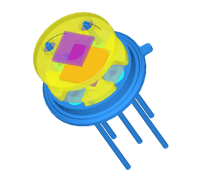

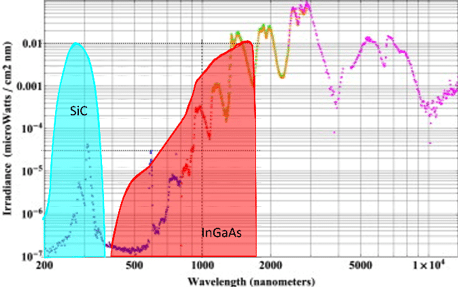
The emission spectrum of gas burners has peaks in the UV and IR wavelength range (blue and red colour in the picture). sglux TANDEM UV-IR is able to detect both wavelength range separately within one TO-5 package employing a SiC photodiode chip for the UV range and an InGaAs photodiode chip for the IR range. This product is usually applied for circuits compliant to SIL3 level measurements.
What is your multi-spectral measurement task? We accept the challenge!

PHOTODIODEN WITH INTEGRATED BANDPASS FILTER – Example 222nm + UV-C bandpass photodiode


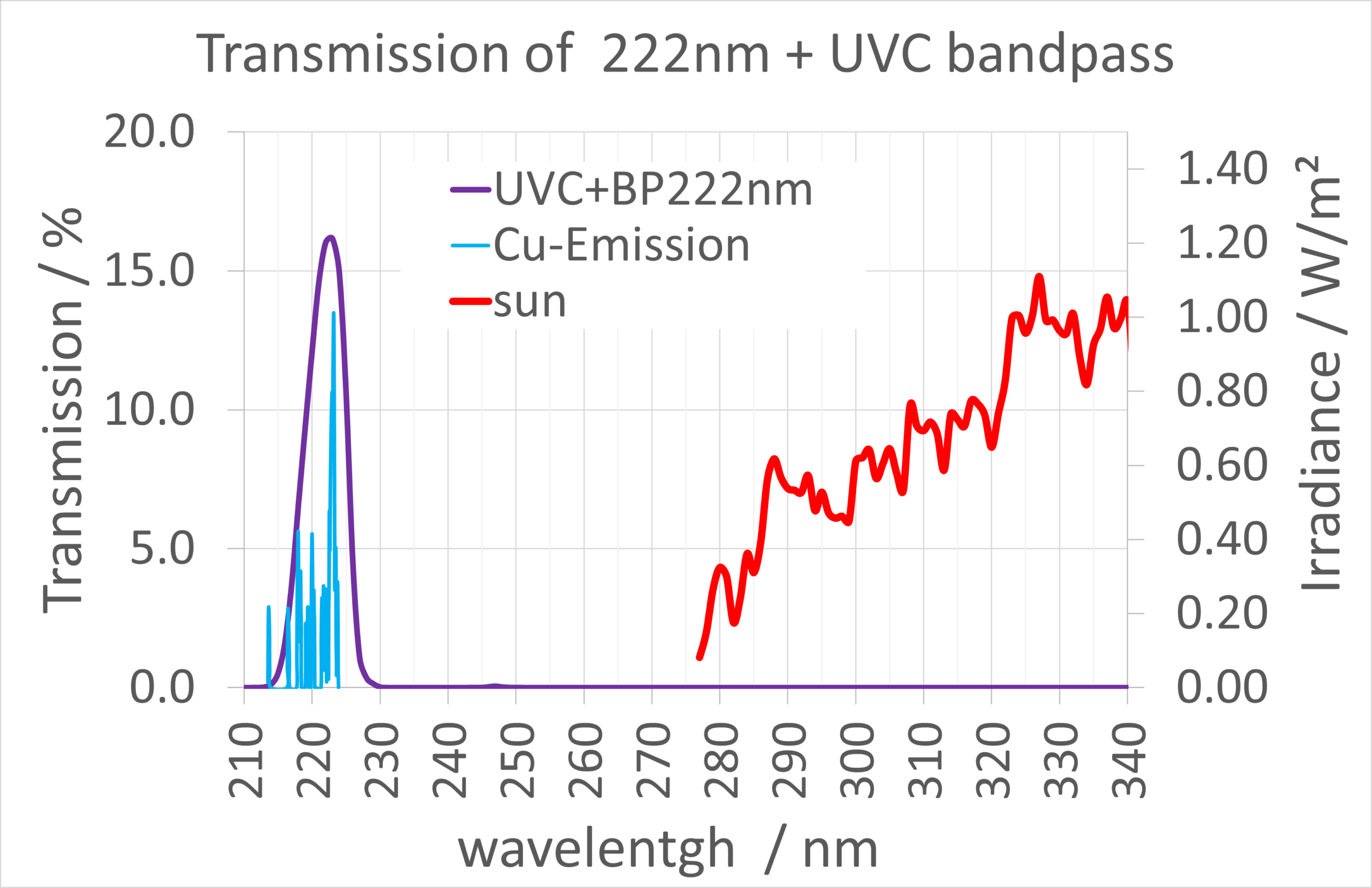
Between the pantograph and the overhead line arcing may occur. The arc spectrum is dominated by copper (Cu) emissions mainly between 220 – 225 nm and 323 – 329 nm. As the measurement needs to be done in the presence of daylight, the 323 – 329 nm Cu-emission-band overlaps with the sun spectrum. Therefore, an arc-detection sensor must be solar blind. sglux solution employs a combined 222 nm narrow band filter (FWHM 10nm) for the detection of the 220 – 225 nm Cu-emission band according to EN 50317.
3 résultats affichés
-

SG04-INGAP-640-5.9
VIS, surface active = 5.9 mm², structure TO5, coefficient de température très faibleDescription du produit- VIS, coefficient de température très faible
- surface du détecteur 5.9 mm²
- structure TO5 encapsulée hermétiquement, deux contacts isolés, un contact supplémentaire à la masse
- une irradiation de 10 mW/cm² à sensibilité du pic produit un courant d’environ 90µA
- InGaP chip
-
SG01-TANDEM-XL
UV + IR, surface active de la puce UV = 7,60mm², surface active de la puce InGaAs = 7,07mm², structure TO5, pour applications dans le domaine de la surveillance des flammes, d'autres modèles peuvent être fabriqués, par exemple avec une puce SiC plus petite (1,82mm²) pour réduire les coûts ou avec des puces juxtaposées plutôt que superposées. L'avantage de cette disposition est une réduction des coûts. économie de coûts supplémentaire, l'inconvénient étant un effort de focalisation plus important. Le capteur IR peut être équipé de filtres, par exemple pour supprimer le rayonnement visible sur la valeur mesurée.Description du produit- photodiodes à double puce pour la mesure simultanée des UV et des IR
- surface active de la detecteur UV = 7,60mm²
- surface active de la detecteur InGaAs = 7,07mm²
- boîtier TO5 encapsulé hermétiquement avec 4 broches isolées
- possibilité de fabriquer d’autres modèles, par ex. avec une puce SiC plus petite (1,82mm²) pour réduire les coûts
- modèles disponibles avec des puces juxtaposées plutôt que superposées
- possibilité d’équiper le capteur IR de filtres supplémentaires, par ex. pour supprimer le rayonnement visible sur la valeur mesurée
-
SG02-APD-D5
UV Avalanche Photodiodes (SiC), maximum gain 105Description du produit- SiC based avalanche photodiode (APD)
- broadband UVA+UVB+UVC, PTB reported high chip stability
- active area A = 0.20 mm²
- TO5 hermetically sealed metal housing, two isolated pins, one additional grounded pin
- max. gain is 105