

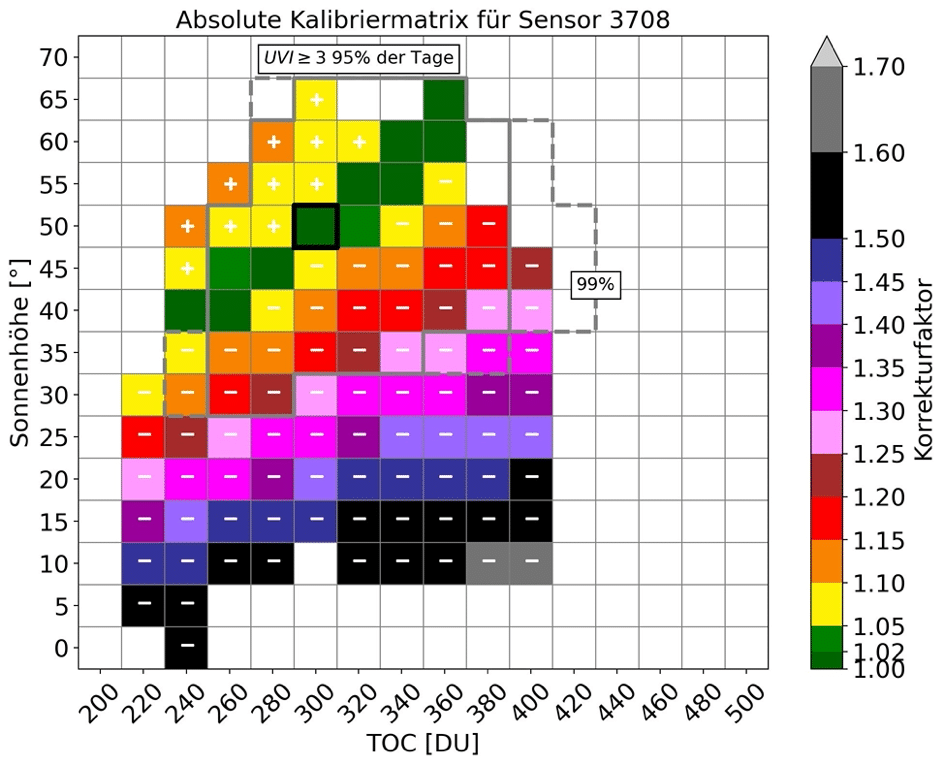
UV-Calibration, Correction Matrix, UV index
- Determination of a correction matrix for UV Index sensors for reduction of the total measurement uncertainty down to <3%
- incl. calibration certificate according to guidance DAkkS 71 SD 0 025 and ISO 17025
Prix unitaire: 1.500,00€
Publications
InterAqua Japan 01. – 03.02.2023
Approaches of LED in-line measurements and its traceable calibration
Abstract
UV measurement at UV LED arrays.
Space Sci Rev (2021) 217:58
Perseverance’s Scanning Habitable Environments with Raman and Luminescence for Organics and Chemicals (SHERLOC) Investigation
Abstract
The Scanning Habitable Environments with Raman and Luminescence for Organics and Chemicals (SHERLOC) is a robotic arm-mounted instrument on NASA’s Perseverance rover. SHERLOC has two primary boresights. The Spectroscopy boresight generates spatially resolved chemical maps using fluorescence and Raman spectroscopy coupled to microscopic images (10.1 μm/pixel). The second boresight is a Wide Angle Topographic Sensor for Operations and eNgineering (WATSON); a copy of the Mars Science Labora- tory (MSL) Mars Hand Lens Imager (MAHLI) that obtains color images from microscopic scales (∼13 μm/pixel) to infinity. SHERLOC Spectroscopy focuses a 40 μs pulsed deep UV neon-copper laser (248.6 nm), to a ∼100 μm spot on a target at a working distance of ∼48 mm. Fluorescence emissions from organics, and Raman scattered photons from organics and minerals, are spectrally resolved with a single diffractive grating spectrograph with a spectral range of 250 to ∼370 nm. Because the fluorescence and Raman regions are natu- rally separated with deep UV excitation (<250 nm), the Raman region ∼ 800 – 4000 cm−1 (250 to 273 nm) and the fluorescence region (274 to ∼370 nm) are acquired simultaneously without time gating or additional mechanisms. SHERLOC science begins by using an Aut- ofocus Context Imager (ACI) to obtain target focus and acquire 10.1 μm/pixel greyscale images. Chemical maps of organic and mineral signatures are acquired by the orchestration of an internal scanning mirror that moves the focused laser spot across discrete points on the target surface where spectra are captured on the spectrometer detector. ACI images and chemical maps (< 100 μm/mapping pixel) will enable the first Mars in situ view of the spa- tial distribution and interaction between organics, minerals, and chemicals important to the assessment of potential biogenicity (containing CHNOPS). Single robotic arm placement chemical maps can cover areas up to 7×7 mm in area and, with the < 10 min acquisition time per map, larger mosaics are possible with arm movements. This microscopic view of the organic geochemistry of a target at the Perseverance field site, when combined with the other instruments, such as Mastcam-Z, PIXL, and SuperCam, will enable unprecedented analysis of geological materials for both scientific research and determination of which sam- ples to collect and cache for Mars sample return.
¹LACy, Laboratoire de l’Atmosphère et des Cyclones (UMR 8105 CNRS, Université de La Réunion, Météo-France), 97744 Saint-Denis de La Réunion, France.
²School of Chemistry and Physics, University of KwaZulu-Natal, Durban 4041, South Africa. ³Laboratoire d’Optique Atmosphérique, Université Lille, CNRS, UMR 8518, F-59000 Lille, France. ⁴Observatoire des Sciences de l’Univers de la Réunion, UMS 3365, 97744 Saint-Denis de la Réunion, France.
⁵Reuniwatt, 97490 Sainte Clotilde de la réunion, France.
⁶Department of Geography, Geo-informatics and Meteorology, University of Pretoria, Pretoria 0002, South Africa.
⁷Environment and Health Research Unit, South African Medical Research Council, Pretoria 0001, South Africa.
Int J Environ Res Public Health. 2020 Apr 21;17(8):2867. doi: 10.3390/ijerph17082867
Abstract
Measurement of solar ultraviolet radiation (UVR) is important for the assessment of potential beneficial and adverse impacts on the biosphere, plants, animals, and humans. Excess solar UVR exposure in humans is associated with skin carcinogenesis and immunosuppression. Several factors influence solar UVR at the Earth’s surface, such as latitude and cloud cover. Given the potential risks from solar UVR there is a need to measure solar UVR at different locations using effective instrumentation. Various instruments are available to measure solar UVR, but some are expensive and others are not portable, both restrictive variables for exposure assessments. Here, we compared solar UVR sensors commercialized at low or moderate cost to assess their performance and quality of measurements against a high-grade Bentham spectrometer. The inter-comparison campaign took place between March 2018 and February 2019 at Saint-Denis, La Réunion. Instruments evaluated included a Kipp&Zonen UVS-E-T radiometer, a Solar Light UV-Biometer, a SGLux UV-Cosine radiometer, and a Davis radiometer. Cloud fraction was considered using a SkyCamVision all-sky camera and the Tropospheric Ultraviolet Visible radiative transfer model was used to model clear-sky conditions. Overall, there was good reliability between the instruments over time, except for the Davis radiometer, which showed dependence on solar zenith angle. The Solar Light UV-Biometer and the Kipp&Zonen radiometer gave satisfactory results, while the low-cost SGLux radiometer performed better in clear sky conditions. Future studies should investigate temporal drift and stability over time.
¹University of Veterinary Medicine, Unit of Physiology and Biophysics, Vienna, Austria, ²PMOD/WRC, Davos Dorf, Switzerland, ³Medical Univ. Innsbruck, Innsbruck, Austria, ⁴Royal Meteorological Institute of Belgium, Observations, Brussels, Belgium, ⁵Royal Belgian Institute for Space Aeronomy, Brussels, Belgium, ⁶Bulgarian Academy of Sciences, Stara Zagora, Bulgaria, ⁷Metorological and hydrological institute of Croatia, Metorological and hydrological institute of Croati, Croatia, ⁸Czech Hydrometeorological Institute, Solar and Ozone Department, Hradec Kralove, Czech Republic, ⁹Danish Meteorological Institute, Copenhagen, Denmark, ¹⁰Tartu Observatory, Tartumaa, Estonia, ¹¹Finnish Meteorological Institute, Helsinki, Finland, ¹²Météo-France, Toulouse Cedex, France, ¹³Bundesamt fur Strahlenschutz Neuherberg, Section for Optical Radiation, Neuherberg, Germany, ¹⁴sglux GmbH, Berlin, Germany, ¹⁵Aristotle University of Thessaloniki, Greece, ¹⁶Hungarian Meteorological Service, Marczell György Main Observatory, Budapest, Hungary, ¹⁷Sapienza Universita’ di Roma, Physics Department, Rome, Italy, ¹⁸ISPRA, Physical Agents Unit, Rome, Italy, ¹⁹ARPA Valle d’Aosta loc, Saint-Christophe, Italy, ²⁰LaMMA Consortium, Institute of Biometeorology of the National Research Council, Sesto Fiorentino, Italy, ²¹CNR-IBIMET, Florence, Italy, ²²ARPA di Vicenza, Vicenza, Italy, ²³National Research Council, Institute of Atmospheric Sciences and Climate, Bologna, Italy, ²⁴ENEA, Laboratory for Observations and Analyses of the Earth and Climate, Rome, Italy, ²⁵Lycée Classique de Diekirch, Computarium and meteoLCD, Diekirch, Luxembourg, ²⁶University of Malta, Institute for Sustainable Energy, Marsaxlokk, Malta, ²⁷Institute of Applied Physics of the Academy of Sciences of Moldova, Kishinev, Moldova (the Republic of), ²⁸Dutch National Health Institute (RIVM), Netherlands, ²⁹NILU – Norwegian Institute for Air Research, Kjeller, Norway, ³⁰University of Oslo, Institute of Physics, Oslo, Norway, ³¹Statens Stralevern, Monitoring and Research, Oesteras, Norway, ³²Institute of Meteorology and Water Management, Gdynia, Poland, ³³Institute of Geophysics, Polish Academy of Sciences, Warszw, Poland, ³⁴Instituto Português do Mar e da Atmosfera, Observatório Afonso Chaves, Ponta Delgada S. Miguel, Portugal, ³⁵Moscow State University, Moscow, Russian Federation, ³⁶University of Belgrade, Zemun, Serbia, ³⁷University of Novi Sad, Novi Sad, Serbia, ³⁸Slovenian Environment Agency, Ljubljana, Slovenia, ³⁹Slovakian Academy of Sciences, Tatranska Lomnica, Slovakia, ⁴⁰Spanish Meteorological Agency, Area of Atmospheric Observation Networks, Madrid, Spain, ⁴¹University of Valladolid, Valladolid, Spain, ⁴²National Institute for Aerospace Technology, Mazagon, Spain, ⁴³University of Extremadura, Department of Physics, Badajoz, Spain, ⁴⁴SMHI, Norköpping, Sweden, ⁴⁵MeteoSwiss, Atmospheric data division, Payerne, Switzerland, ⁴⁶University of Manchester, Manchester, United Kingdom of Great Britain and Northern Ireland, ⁴⁷Public Health England Centre for Radiation Chemical and Environmental Hazards, Radiation Dosimetry, Didcot, United Kingdom of Great Britain and Northern Ireland
Journal: Photochemical & Photobiological Sciences, Publisher: The Royal Society of Chemistry.
Abstract
The UV Index was established more than 20 years ago as a tool for sun protection and health care. Shortly after its introduction, UV Index monitoring started in several countries either by newly acquired instruments or by converting measurements from existing instruments into the UV Index. The number of stations and networks has increased over the years. Currently, 160 stations in 25 European countries deliver online values to the public via the Internet. In this paper an overview of these UV Index monitoring sites in Europe is given. The overview includes instruments as well as quality assurance and quality control procedures. Furthermore, some examples are given about how UV Index values are presented to the public. Through these efforts, 57% of the European population is supplied with high quality information, enabling them to adapt behaviour. Although health care, including skin cancer prevention, is cost-effective, a proportion of the European population still doesn’t have access to UV Index information.
¹sglux GmbH, Berlin, Germany, ²Physikalisch-Technische Bundesanstalt Braunschweig und Berlin (PTB), 4.1 Photometry and Applied Radiometry, Braunschweig, Germany
EMEA Regional Conference, Karlsruhe, Germany (2013)
¹Physikalisch-Technische Bundesanstalt Braunschweig und Berlin (PTB), 4.1 Photometry and Applied Radiometry, Braunschweig, Germany, ²sglux GmbH, Berlin, Germany
EMEA Regional Conference, Karlsruhe, Germany (2013)
Abstract
PTB provides spectral irradiance calibrations traceable to national primary standards and the SI system. Transportable spectroradiometer systems have been adapted for high UV irradiance measurements. Successful measurements at medium pressure Hg and low pressure Hg lamp facilities have been carried out. The effective microbicidal irradiances agree within 15%. 40° sensor geometry could be developed. Discussion about calibration service and support.
¹Physikalisch-Technische Bundesanstalt Braunschweig und Berlin (PTB), 4.1 Photometry and Applied Radiometry, Braunschweig, Germany, ²sglux GmbH, Berlin, Germany
EMEA Regional Conference, Karlsruhe, Germany (2013)
Abstract
PTB provides spectral irradiance calibrations traceable to national primary standards and the SI system. A transfer standard source for high UV irradiances has been constructed and characterized. A medium pressure Hg lamp and a low pressure Hg lamp provide different spectra at different irradiance levels. The system might serve as a calibration facility for DVGW & ÖNORM conform UV sensors. Calibration by direct substitution to reference sensors can be carried out.
¹Ferdinand-Braun-Institut, Leibniz-Institut fuer Hoechstfrequenztechnik, Berlin, Germany, ²Leibniz-Institut fuer Kristallzuechtung, Berlin, Germany, ³Physikalisch-Technische Bundesanstalt Braunschweig und Berlin (PTB), 4.1 Photometry and Applied Radiometry, Braunschweig, Germany, ⁴sglux GmbH, Berlin, Germany
J. Mater. Res., first view (2012).
Abstract
Highly efficient polytype 4H silicon carbide (4H-SiC) p–n diodes for ultraviolet (UV) light detection have been fabricated, characterized, and exposed to high-intensity mercury lamp irradiation (up to 17 mW/cm²). The behavior of the photocurrent response under UV light irradiation using a low-pressure mercury UV-C lamp (4 mW/cm²) and a medium-pressure mercury discharge lamp (17 mW/cm²) has been studied. We report on long-term UV photoaging tests performed for up to 22 mo. Results demonstrate the robustness of SiC photodiodes against UV radiation. The devices under test showed an initial burn-in effect, i.e., the photocurrent response dropped by less than 5% within the first 40 h of artificial UV aging. Such burn-in effect under UV stress was also observed for previously available polytype 6H silicon carbide (6H–SiC) p–n photodetectors. After burn-in, no measurable degradation has been detected, which makes the devices excellent candidates for high irradiance UV detector applications.